Why every construction project needs a Surplus Diversion Certificate
The construction industry has always measured progress in square feet built, concrete poured, and projects delivered.
The next decade will measure something else alongside it: how much waste was prevented before it was ever created.
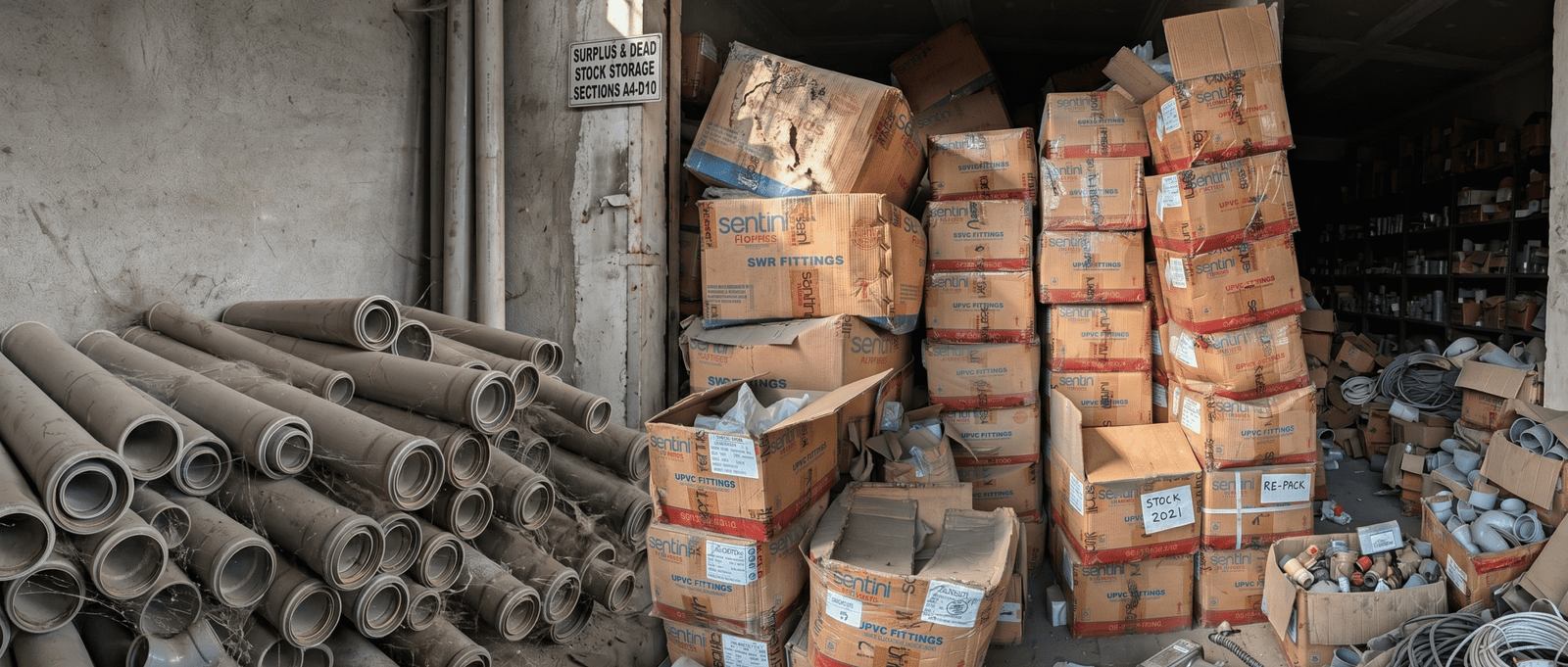
Every project generates surplus over-ordered tiles, steel bars, sanitary fittings, lighting fixtures, doors. Materials still in usable condition, sitting idle because procurement buffered for uncertainty, or a design changed mid-build. Traditionally, this gets written off as a financial loss and forgotten.
It is not just a financial loss. It is an environmental one too.
Every unused material carries embodied carbon the emissions locked in during extraction, manufacturing, packaging, and transport, before the material ever reaches site. Discard it, and a replacement gets manufactured somewhere else, doubling the footprint for the same square foot of building.
This is the problem the Surplus Diversion Certificate (SDC) is built to solve.
What an SDC actually certifies
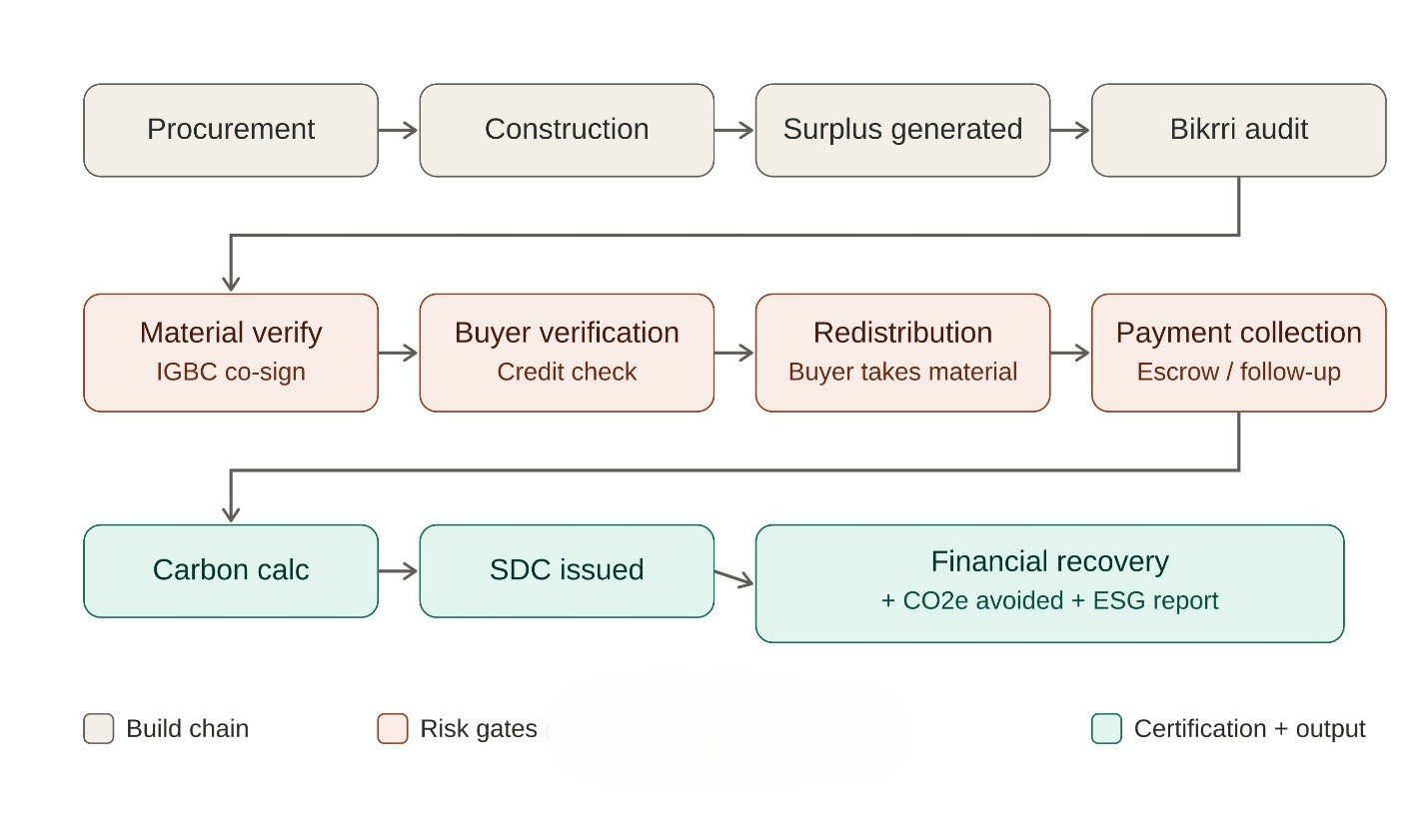
A Surplus Diversion Certificate is a professional audit document not a spreadsheet, not a self-reported estimate that records and certifies the quantity of construction material diverted from disposal through verified reuse, redistribution, or resale.
At Bikrri, every SDC is issued under Bikrri Audit Protocol v1.0 and co-signed by IGBC Accredited Professional. That co-signature is not a formality. It is the credibility gate that makes the certificate defensible to an auditor, a lender, or an ESG reporting team who will ask, correctly, "who verified this and against what standard?"
Each SDC documents:
- Physically verified surplus materials, with quantity and condition grading
- Diversion channel where the material went and to whom
- Financial value recovered
- Total material diverted, by weight and category
- Carbon emissions avoided, calculated against ICE Database v3 (University of Bath)
- Compliance positioning against the C&D Waste Management Rules, 2025
This turns surplus from a line item nobody tracks into measurable business intelligence.
What this looks like on an actual project – A small example
In April 2026, Bikrri audited surplus at XYZ site. The certified numbers:
- ₹13,69,000 in verified surplus material value
- 69.7% recovery ratio against total surplus generated
- 21.17 tCO₂e avoided roughly the annual sequestration of 1,000 trees, using IFRI's per-tree offset benchmark
That is the difference between saying "we reduced waste" and saying: this site diverted ₹13.69 lakh in material value and avoided 21 tonnes of CO₂e, independently verified. One is a claim. The other is a number a green-bond underwriter or an IGBC reviewer can actually use.
Why carbon math changes procurement, not just reporting
Most carbon accounting in construction stops at electricity, fuel, and site transport operational carbon. Almost nobody measures the embodied carbon sitting in materials that were bought, never used, and quietly discarded.
Run this audit across multiple projects, and patterns surface fast: which materials get over-ordered consistently, which suppliers' packaging drives handling losses, which design-change points create the most waste. That's not sustainability reporting that's procurement intelligence a builder can act on for the next project.
Good surplus management is good business before it's good ESG.
The compliance backdrop
The C&D Waste Management Rules, 2025, effective 1 April 2026, mandate EPR registration and graded recycling targets for projects above 20,000 sqm BUA. Most of the industry's response to this will be downstream recycling, crushing, landfill diversion after the fact.
Bikrri's audit sits upstream of that. Material diverted before it becomes waste never enters the EPR calculation at all. That's a stronger position than a recycling credit, and it's the one most developers haven't priced in yet.
From waste management to circular construction
The sustainability hierarchy, in order of value: reduce, reuse, redistribute, recycle. The industry has spent two decades optimizing for the last step. An SDC documents movement on the first three which is where the actual carbon and cost savings live.
Where this is heading
Within the next few years, carbon disclosure will sit next to financial disclosure for construction projects seeking institutional capital or green certification. The question won't just be "how much did you build." It will be "how much did you divert, and can you prove it."
Bikrri exists to answer that question with a signed, methodologically anchored certificate not an estimate.
Because the future of construction won't be measured only by what gets built.
It will be measured by what gets saved, and by who can prove it.
Bikrri is a Pune-based audit and certification platform for construction surplus, issuing Surplus Diversion Certificates under Bikrri Audit Protocol v1.0.